
Use cases for review by Insulet hiring team
These 3 case studies have been curated for you. If you prefer a downloadable PDF click here.

Empowering
a
Global Sales Force Through Digital Innovation
Stryker | Crossfire App
The Challenge
Our international sales force reported low product adoption and stagnant sales, citing a lack of confidence in customizing complex medical device settings for clinicians. The primary friction point was the inability to configure device parameters on-demand in high-stakes clinical environments.

“I don’t offer these devices to my clients because I cannot explain the customization, and I fear being asked to configure settings during a surgical procedure.“
The Goal
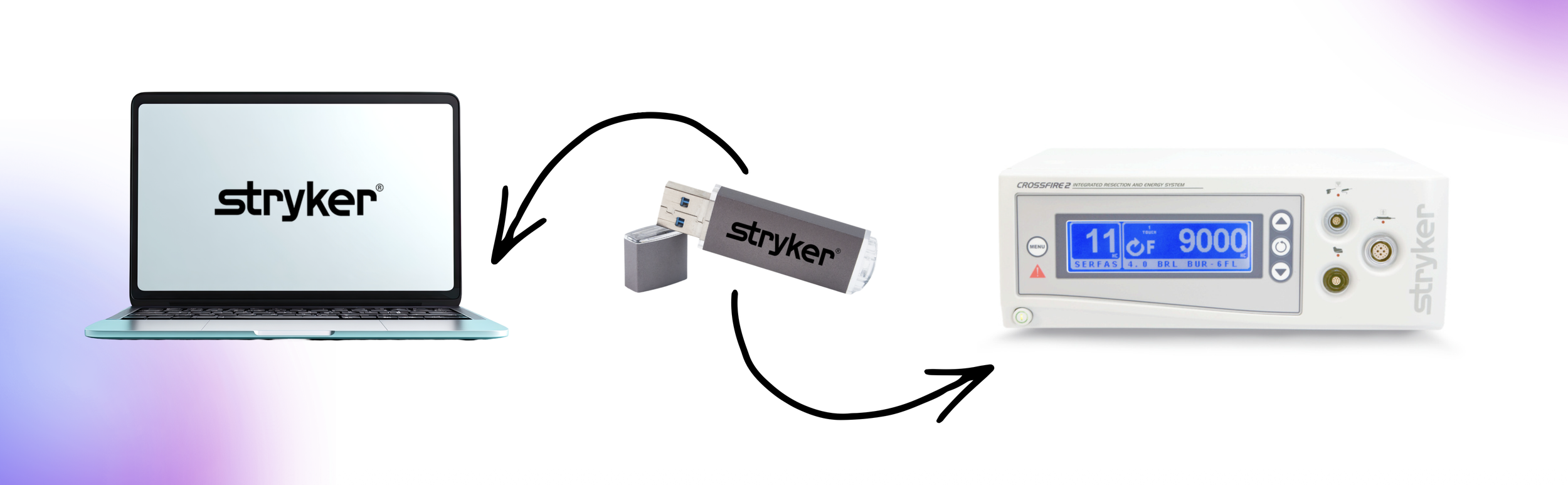
Develop a lightweight, portable configuration application that enables sales representatives to tailor medical device settings on any workstation and seamlessly transfer those configurations to the device within an operating room setting.
The Strategy & Execution
Strategic Architecture:
Partnered with a Java developer to architect a portable configuration tool, utilizing an HTML front-end and Java back-end designed to run directly from a company-issued thumb drive.
Granular UX Design:
During user research and validation cycles with the sales force, I identified a need for tiered functionality. I expanded the scope to include "Basic" and "Advanced" modes, providing sales teams with the necessary granularity to support both routine and specialized clinical requirements.
Collaborative Implementation:
Oversaw the end-to-end design lifecycle, ensuring the interface was intuitive enough for non-technical users while robust enough for complex surgical applications.
The Impact
Confidence & Adoption:
Sales representatives confidence increased from 20% to 80%, shifting from avoiding the product to actively demonstrating it, directly resulting in a 5% increase in device sales within the first month.
Customer Satisfaction:
By reducing the time-to-configure from hours to minutes, the tool drastically improved the surgeon’s workflow, leading to a 10% increase in customer satisfaction within the first 90 days.
“I used the application today with a client. They were impressed that I could achieve complete customization in minutes—a process that used to take hours. I now feel empowered to offer these devices to more hospitals with full confidence.”
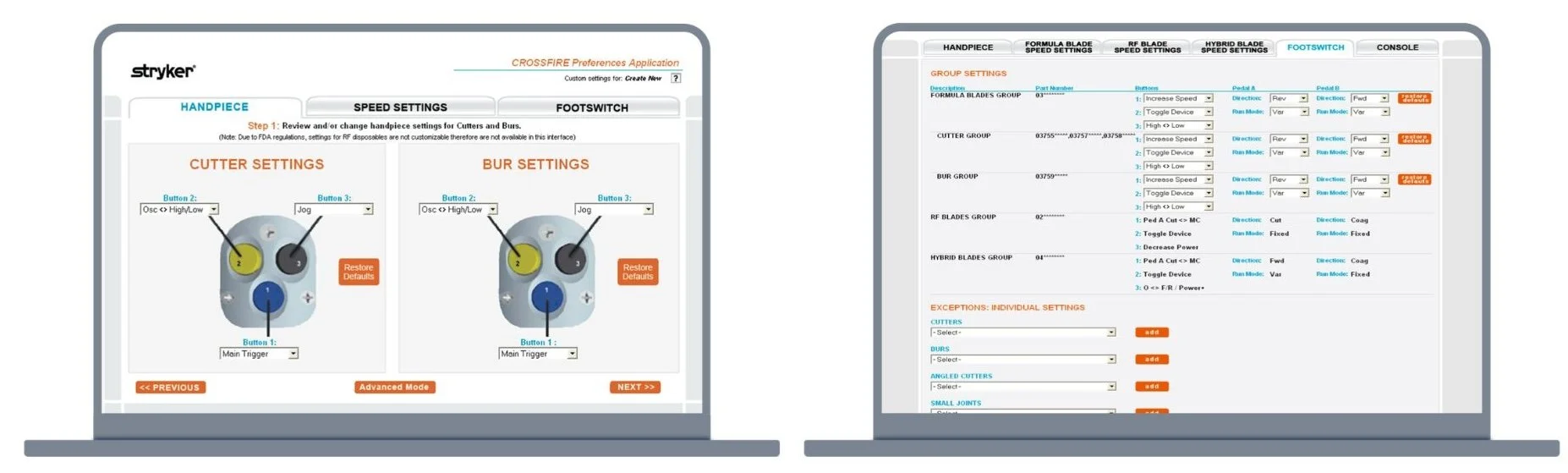
Stryker Crossfire UI showing the basic customizable cutter and bur settings (Left). "Advanced Mode" granular configuration, demonstrating a tiered user experience design (Right)

Defining a
Best in Class
Mobile Bill Payment Experience
U.S. Bank | Pay Bills
The Challenge
Bill Pay had remained stagnant for a decade, constrained by legacy vendor architecture that was not available on mobile.
To fit in the limited mobile real estate, and be accessible, Bill Pay needed a 0-to-1 overhaul with focus on innovation, human-centered design and a mobile first approach.
We aimed to redefine the mobile payment experience to be intuitive, accessible, and scalable, moving from a manual task to a frictionless, "best-in-class" digital ecosystem, while managing complexity in this strict regulatory space.

Example of a user flow from one of the user journeys
The Execution
Stakeholder Alignment:
Partnered with 8 Lines of Business (LOB) Product Owners to architect and unify the experience strategy for 24 distinct use cases, ensuring feature parity and consistency across a complex product ecosystem.
Service Design:
Developed comprehensive end-to-end user journeys and service blueprints to visualize technical and operational touchpoints, facilitating early-stage buy-in and securing formal approval from Risk and Compliance stakeholders.
The Foundation
Evidence-Based Design Strategy: Partnered with researchers to execute large-scale validation studies involving over 700 participants, moving our design strategy from assumption-based output to empirical, data-validated solutions.
Institutionalizing Insights:
These studies became a foundational "Insights Library" for the Money Movement portfolio, democratizing access to user data and establishing a single source of truth to inform future product roadmap decisions and design iterations.
Design System Adoption: Developed a new UI kit and pattern library that for the entire "Move Money" product group.
Developed 30 new component patterns for adoption into the standard Design System and Commons Library.

The Impact
Customer Satisfaction: Achieved a 79% user satisfaction rating, In first quarter of release.
CSAT was maintained and increased over the 4 years under my leadership.
Platform Growth:
Directly contributed to increasing the user base from 5M to 8M active users over four years.
This experience was awarded Best in Class by industry papers in 2023, 2024 and 2025.

Innovating ACH payments for the Small Business User
U.S. Bank | ACH Payments
The Challenge
The Business Banking division identified a critical customer segment gap that our existing legacy architecture could not support. The challenge was two-fold:
we needed to build a robust, feature-rich solution that provided immediate value to the customer, while ensuring the underlying technical framework was scalable, maintainable, and revenue-generating for the bank.
Operating within a strictly regulated environment, this initiative demanded a complete ground-up redesign delivered within a high-stakes 18-month timeline. As a lead for one of six integrated product teams, I was responsible for driving cross-functional alignment, managing complex stakeholder dependencies, and ensuring that our design strategy remained cohesive across a massive, multi-team ecosystem.
The Strategy & Execution
Governance & Cross-Functional Alignment:
Orchestrated end-to-end design strategy across six business units, partnering with Legal, Risk, and Compliance leadership to ensure all product functionality met stringent regulatory standards while maintaining a cohesive, unified user experience.
Strategic Alignment:
Partnered with 6 stakeholder teams, legal, risk and compliance representatives to drive consistent experiences and funcationality while meeting regulatory requirements
Developed 6, 12 and 18 month roadmap release schedules to ensure allignment and progress.
The Research Culture
Pioneering Design Maturity:
Inheriting a product organization with no existing research infrastructure or behavioral tracking, I led the 0-to-1 buildout of a research framework. My team and I established the group’s first research studies, proving the value of data-driven insights and moving the portfolio from intuitive design to one built on validation.
Scaling Research Capability:
To ensure long-term impact,
I mentored and trained three designers in research best practices and our vendor research tool, empowering them to independently conduct and validate high-stakes studies.
Integrating Behavioral Analytics: Partnered with Product Owners to architect data-collection telemetry directly into the product’s core features, creating a continuous loop of behavioral insights that now informs all future roadmap prioritizations.
The Impact
Early-Stage Adoption:
Following a single quarter of pilot deployment, initial performance metrics indicate strong user adoption potential. Data-driven insights from this phase are currently validating our hypothesis for growth and providing the empirical foundation for a full-scale market rollout.
The "One-Year Evolution":
This initiative served as a catalyst for a fundamental shift in the organization’s culture. By unifying 6 previously siloed teams under a single, synchronized roadmap and release schedule, we transformed our delivery model from fragmented execution to a cohesive, high-velocity engine.
“I thought it was impossible to align this many people and push out this level of work. I never had data to help prioritize my decisions. It’s a whole new world.”
The Visuals
Collaboration Note: These outcomes were achieved through a highly iterative, cross-functional team effort. As the design lead, I directed the overall strategy and conducted final reviews of all deliverables, while remaining actively involved in the day-to-day design execution to support my team in overcoming complex technical and functional hurdles.
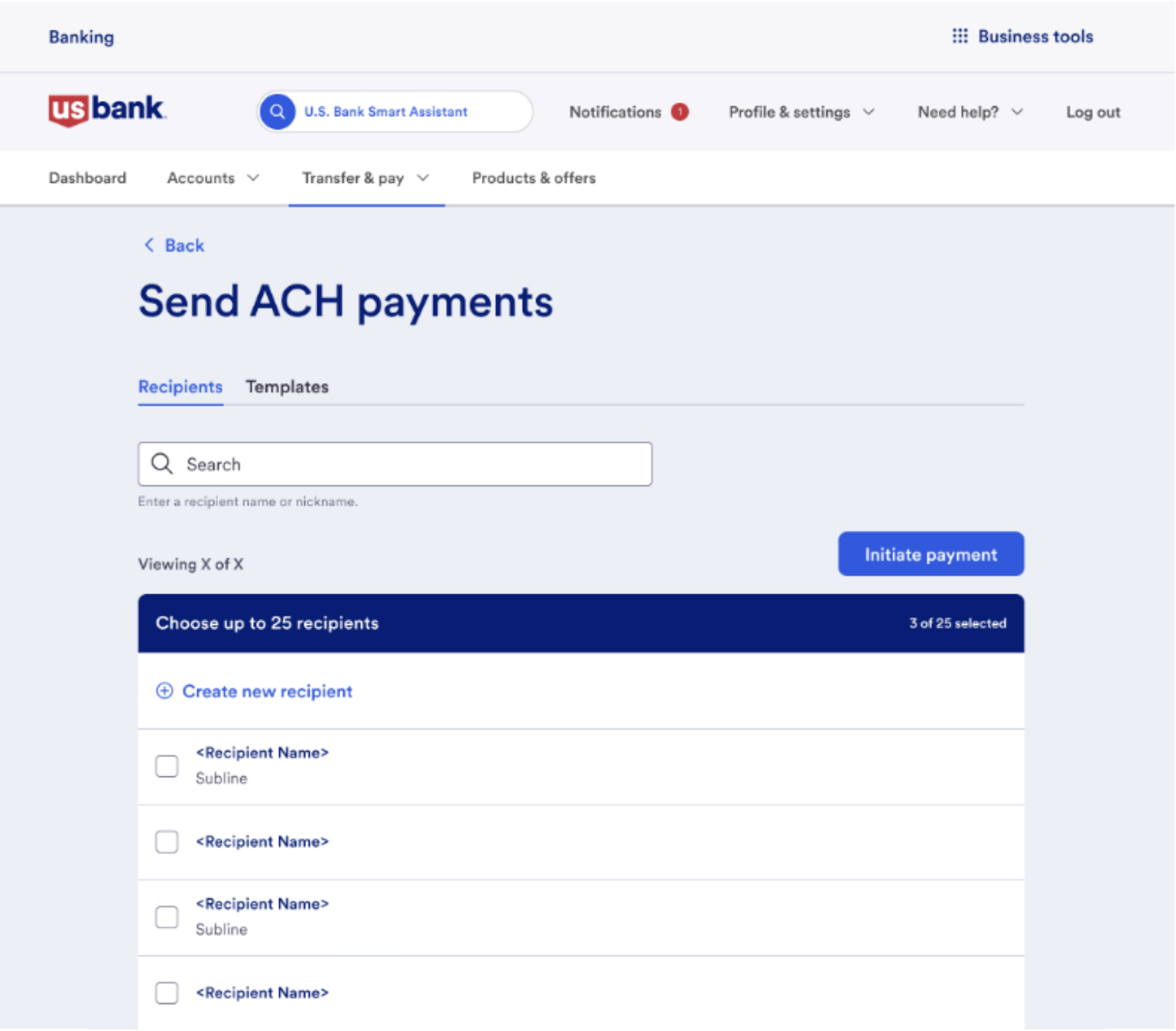
Scalability Overhaul: Rearchitected the recipient selection to support multiple recipients, allowing for higher efficency.
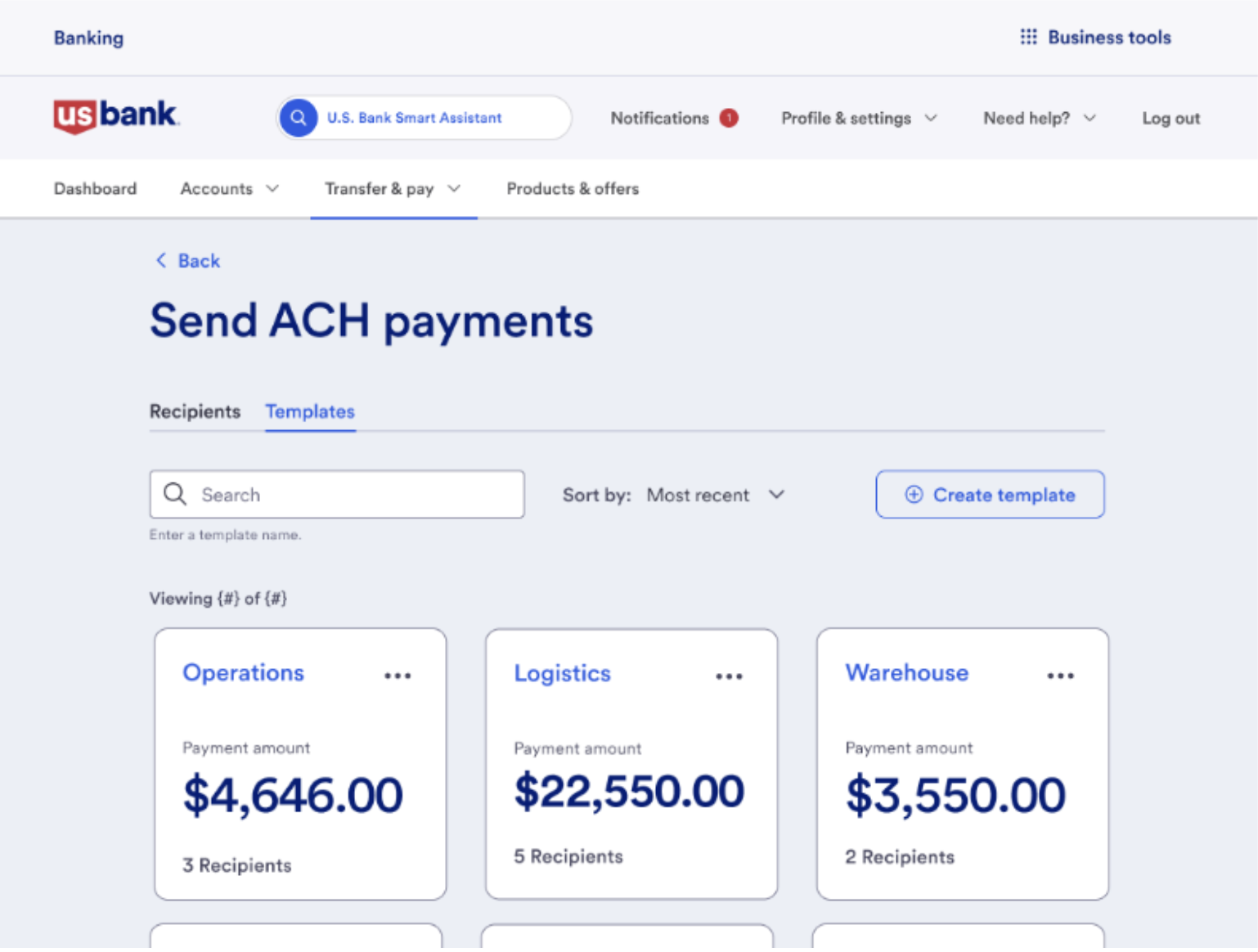
0-1 Design: Introduced ' Templates' feature, enabling users to store and reuse transactions, or set them on a recurring cadence. This streamlined common workflows and reduced time-on-task for our core customer segment.
Strategic Friction Reduction:
Streamlined the ACH enrollment workflow by partnering with Product, Risk, and Legal to reduce the questionnaire from six steps to two essential regulatory requirements.
Operational Strategy:
By architecting a solution where non-critical data is captured through automated backend telemetry and risk-flagging rather than manual user input, we maintained full compliance while significantly increasing conversion and reducing onboarding abandonment.
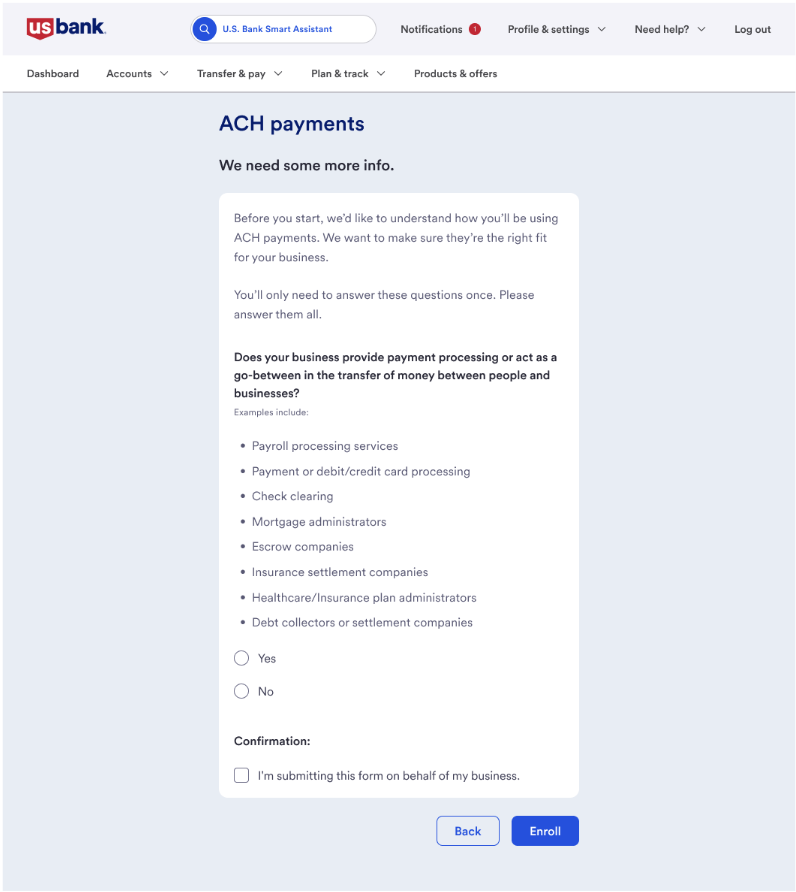
New Enrollment
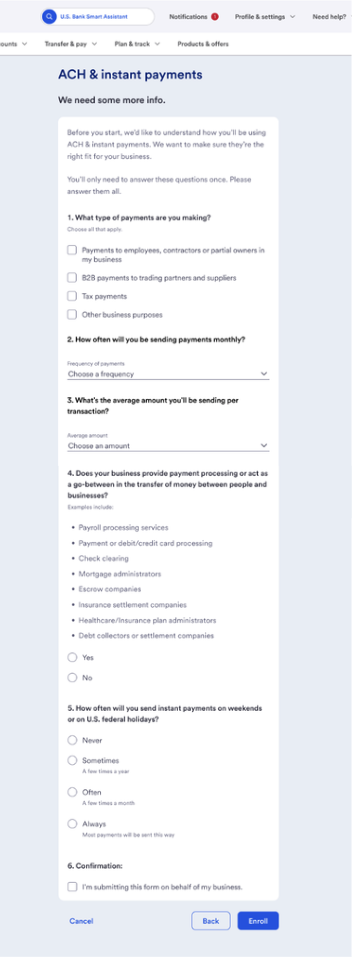
Original Enrollment
Thank you for your time and consideration.